Loan programs → Ground-up construction loans
Ground-up construction loans
A ground-up construction loan funds a new build on land you already own or control, released in draws as the project is built. Capstone Connectors is an Asheville private money broker: we connect investors and builders with lending partners who fund that loan. We do not lend.
In short
- →New construction. Not a rehab of a house that is already standing.
- →Land owned outright, or structured with the seller. The project is shovel-ready: permits and site tests done.
- →Up to 70% loan-to-cost, released in draws as milestones complete. Term sized to the build.
- →Business-purpose, non-owner-occupied investment property only. Not a primary residence. Not North Dakota or South Dakota.
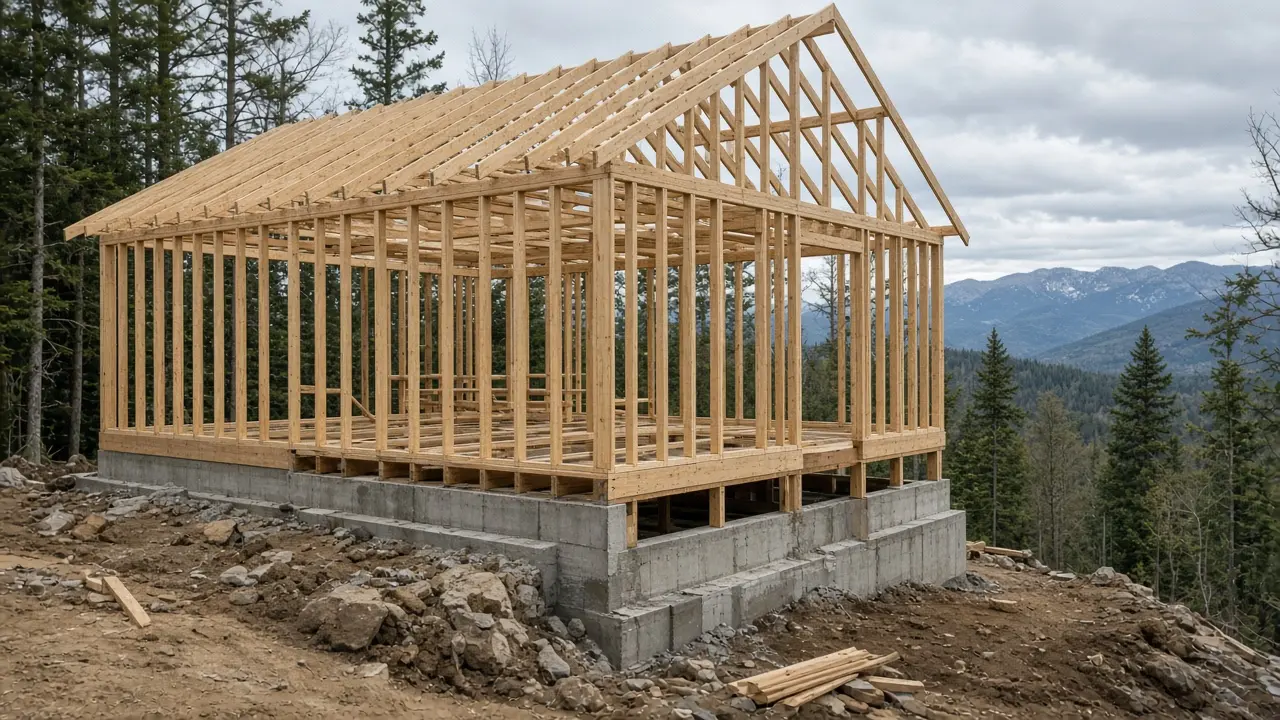
Reviewed by Derek Simkins, an Asheville private money broker. He matches investor deals with lending partners. He does not lend. Last updated October 21, 2026. The photograph is a house under construction. It is not a Capstone project.
The sequence
How a ground-up construction loan moves.
The loan exists to pay for a building that is not there yet. That is why partners will not treat it like a flip of a standing house, and why the file starts with land and paper, not with a renovation punch list. Capstone introduces the project. The partner funds it, or does not.
- 01
Control the land.
You own it, or you have an agreement with the seller that gives you control. A hopeful listing is not control. Land you already own often counts toward the equity the partner wants to see. How they count it is their rule, not a slogan.
- 02
Make it shovel-ready.
Permits issued. Site tests done — whatever that lot actually requires, not a generic checklist from another county. Plans, a builder, and a budget with line items. In the mountains around Asheville, construction cost is where outside budgets go wrong. Price the build you are actually putting on that slope, not a flat-land allowance.
- 03
Name the exit before the first draw.
Sell the finished house, or refinance it as a rental with a DSCR loan once it is rented. Both are real. “We will see what the market does” is not. The term on the rates page is project-driven, and extensions are case by case. The calendar still ends.
- 04
Capstone makes one introduction.
Derek reads the land, the budget, the permits, and the exit, then matches the project to a lending partner whose box fits. He does not lend, and he does not set the rate. The partner underwrites. On a clean file, closing is days, not weeks. Permits, title, and entity papers are the usual delays, same as any other investor loan.
- 05
Draw against work that is already in place.
You complete a milestone, document it, and request the draw. The partner verifies the work and releases that piece. You are reimbursed for progress. You are not handed the full budget at the closing table. Interest, on the pattern this page has always described, is often charged only on funds drawn so far, so the payment grows as the building does. Confirm that on the note. Fix-and-flip partners more often charge Dutch interest on the whole loan, including money still in escrow. These are different products. Do not model one with the other’s interest.
Plain terms
Cost, draws, term, and what we will not invent.
Loan-to-cost. The loan divided by the total project cost. Partners fund up to 70% of that cost. You bring the rest, plus closing costs and a contingency. The rates page leaves the max loan-to-value cell blank for this product on purpose. We do not publish a finished-value percentage for ground-up the way we publish 70% of after-repair value for a flip.
Draws. A schedule of releases tied to the budget, not a single wire. Typical milestones are whatever the build actually has — site work, foundation, dried-in, mechanicals, finish — and the partner writes the schedule. Inspection or photos come before the wire. Lien waivers and invoices are normal asks. A draw that does not match the budget does not get “close enough.”
Interest during the build. Usually interest-only, and often only on the outstanding drawn balance, so a quiet month costs less than a month when the framer just got paid. There is no Capstone rate to multiply by a loan amount. Anyone quoting you a payment without the partner’s rate is guessing.
Points, term, prepayment. A point is 1% of the loan, a fee. We do not publish an origination-point range or a prepayment rule for this product. Term is project-driven. Extensions are case by case. The fix-and-flip line on the rates page — 6 months, then 3-month extensions at 1 point, 12 months total — is that product’s line. Do not copy it onto a build unless the partner’s term sheet says so.
After-repair value belongs to the flip. A new building has a finished value, and partners care about it, but the number we are willing to print is the 70% cost cap. If a partner also caps loan-to-finished-value, that cap is theirs to quote on your project.
Example
Example: 70% of cost, and the cash that is still yours.
Example only. Invented prices, so the 70% is easy to see. Not a Capstone project, not a client, and not a quote. No interest rate, because we do not have one to apply.
| Land, already owned | $100,000 |
|---|---|
| Construction budget | $200,000 |
| Total project cost | $300,000 |
| 70% of cost | $210,000 |
| The other 30% | $90,000, before closing costs and a contingency |
If the partner counts the land toward equity, a large piece of that $90,000 is the dirt you already paid for. You still need cash for closing costs, for the gap the land does not cover, and for the trades you pay before a draw reimburses you. A contingency is not optional in the mountains. A budget with nothing set aside for rock, access, or a failed test is the budget that stops the job.
The $210,000 does not arrive at closing. It arrives in draws as work is verified. If interest is charged only on what has been drawn, the first month’s payment is interest on the first draw, not on $210,000. Confirm the sentence in the note before you model a year of carry.
Fit
Who it fits, and who should use a different loan.
It fits an investor or builder putting up a new investment property: a spec house to sell, or a building you will rent and refinance. You control the land. The permits and tests are done or genuinely in hand. You can fund the equity, the closing costs, and a contingency. Rural and Western North Carolina sites are considered. Capstone is in Asheville. This is not a page for every town.
It does not fit a house you will occupy as a primary residence or a second home. It does not fit a gut rehab of a house that is already standing — use a fix and flip loan. It does not fit a finished rental you are only buying — use a DSCR purchase loan. Capstone does not place ground-up construction loans on property in North Dakota or South Dakota.
Business-purpose, non-owner-occupied investment property loans only. Not for primary residences, second homes, or consumer loans.
Underwriting
What partners look at on a new build.
The deal, in roughly this weight. The partner’s checklist can add items. It will not skip the land or the budget.
Land control and a clean title. Owned, or under a real agreement. Access, easements, and whatever the survey shows.
Permits and site tests. Issued permits, and the tests that lot needs. A file that is “about to be permitted” is not the file that gets construction draws.
Budget against the 70% cap. Hard costs, soft costs, and a contingency. Up to 70% of cost is the published ceiling. The rest is your cash, including land equity if they accept it.
Builder and scope. Who is building, and a scope detailed enough to draw against. A one-line “build the house” budget cannot be inspected.
Exit and carry. A sale you can support, or a rent that can carry a later DSCR loan. Experience matters more when the project is complicated. Cash matters when the schedule slips. Credit is lighter than a bank’s and it is not zero: bankruptcy, a recent foreclosure, and fraud claims are still part of the read.
Documents
The package, before anyone underwrites the build.
- —Deed, or the agreement that controls the land, plus a title commitment when the partner orders one.
- —Issued permits and the site tests.
- —Plans and a line-item budget the draws can follow.
- —Proof of funds for your equity, closing costs, and a contingency.
- —Entity documents if an LLC will own the project: operating agreement and EIN. Most investor loans are made to an entity.
- —A one-page exit, and government-issued ID once the file is open.
This is the starting set from how investor files actually move, not a claim that every partner stops here. Read what they send. Have your own attorney read the note.
The broker
How Capstone works a construction file.
Derek Simkins matches the project. He is in Asheville, he brokers fix-and-flip, construction, bridge, and DSCR through lending partners, and he does not sit on a single fund he can name here. The introduction goes to the partner whose box fits this build. Compensation is paid by the funding lender at closing and disclosed in writing before you close.
What he is checking: land control, whether “shovel-ready” is true, whether 70% of cost leaves you enough cash to finish, and whether the exit is a sale or a DSCR refinance you have actually priced. He coordinates the file. He does not approve it, fund it, or promise a calendar the partner did not sign.
Construction is a harder product than a flip. A no, early, is a better result than a draw schedule that dies at the foundation. Send the site, the budget, and the timeline.
Mistakes
How construction loans stall.
Permits are “coming.”
The partner’s definition of shovel-ready is permits and tests completed. A pending application does not draw.
The budget is a flat-land number.
Mountain sites cost more than a spreadsheet from somewhere flat. No contingency means the 70% cap is reached before the building is dried in.
The interest model is the flip model.
Dutch interest on the whole commitment, and interest only on draws, are different bills. Model the one in your note.
There is no exit except optimism.
A spec house needs a sale you can support. A rental needs a rent that can carry the DSCR loan you plan to take out later. The construction loan will mature either way.
Compared
Ground-up construction next to a flip, a bank build, and a rental loan.
| Ground-up | Fix and flip | Bank construction | DSCR | |
|---|---|---|---|---|
| Asset | New building on land you control | Existing building, renovated | Often the house you will live in | A rental that already exists, or one just finished |
| Published cap | Up to 70% of cost | Up to 100% of cost, 70% of after-repair value | Not our product | Qualified on the rent |
| How money comes out | Draws as the build hits milestones | Purchase at closing, rehab in draws | Their draw process, their income rules | One long-term loan, not a construction escrow |
A bank construction loan can be the right tool when you will occupy the house and you want that lender’s process. It is the wrong tool to pretend this page is. We do not place owner-occupied loans.
Questions
Ground-up construction loans, answered straight.
What is a ground-up construction loan?
A ground-up construction loan funds a new building, not the renovation of a house that is already standing. Lending partners want the land owned or under an agreement with the seller, and the project shovel-ready — permits and site tests done — before construction funds are drawn. Capstone connects you with those partners. We do not lend.
How does a ground-up construction loan work?
You control the land, finish the permits and the site tests the lot needs, and price the build. Capstone introduces the project to a lending partner. If they approve, they fund against cost, not in one check on day one. Draws follow completed milestones. You exit by selling the finished building or by refinancing it into a DSCR loan if you will hold it as a rental. The partner sets the approval.
Do I have to put 20% down on a construction loan?
Not exactly 20%. Most of our lending partners fund up to about 70% of total loan-to-cost, so you typically bring the remaining portion plus closing costs and a contingency. Land you already own often counts toward your equity. The exact amount is set by the matched lending partner based on the deal.
What is the monthly payment on a construction loan?
There is no single number, including on a $300,000 loan. Construction financing is usually interest-only during the build, and partners often charge interest only on the funds drawn so far, not the full loan amount, so the payment grows as the project draws down. The rate is set by the matched lending partner. We do not publish a Capstone construction rate. See the rates page for what we do publish: up to 70% of cost, term sized to the project.
How do construction loan draws work?
Funds are released in draws as construction milestones complete, usually after the work is verified. You fund or order the work, then draw to reimburse, which keeps capital tied to real progress. The draw schedule is sized to your build rather than a fixed template, and it is set by the matched lending partner. A request without pictures, invoices, or a match to the budget waits.
What does shovel-ready mean?
Permits are issued and the site tests the lot actually needs are done, with plans and a budget a partner can underwrite. A pretty rendering and a verbal “the county is fine with it” are not shovel-ready. Construction money follows that package. It does not replace it.
How is this different from a fix and flip loan?
A fix and flip loan renovates a building that already exists. Partners can go up to 100% of purchase-plus-rehab cost on a deal that pencils, still capped at 70% of after-repair value. A ground-up loan builds from land and stops at 70% of project cost. Both are short-term, business-purpose, and drawn as work is completed. Neither is a mortgage on a house you will live in.
Can I live in the house when it is finished?
No. These are business-purpose, non-owner-occupied investment property loans only. Not a primary residence, a second home, or a consumer construction loan from a bank. If the exit is a rental, the long-term piece is a DSCR loan after the build, qualified on the rent. Capstone does not place these loans on property in North Dakota or South Dakota.
Is a ground-up construction loan hard to get?
It comes down to the deal. Partners want the land owned or under control, the project shovel-ready with permits and plans, a clear budget, and a realistic exit. With those in place, business-purpose construction financing is workable, and Capstone helps package the project so it lands with the right lending partner. A loose budget or an unfinished permit set is the usual reason a file does not move. The partner still decides.
What documents should I have ready?
Proof you own the land or a signed agreement that controls it, issued permits, the site tests, plans, a line-item budget, the builder’s scope, proof of funds for your equity, closing costs, and a contingency, entity documents if an LLC will own it, and a one-page exit: sell, or refinance into a DSCR loan. Government-issued ID follows once the file is open. The partner can add to this list.
What is a point, and is there a prepayment penalty?
A point is 1% of the loan amount, charged as a fee. The rates page does not publish a single origination-point figure or a prepayment rule for ground-up construction. Extensions are case by case, and the term is project-driven. Read the partner’s note for prepayment, extension fees, and whether interest is charged on the whole commitment or only on the drawn balance. Do not assume the fix-and-flip extension price applies here.
Can the finished building become a rental?
Yes, as a second loan, not as a conversion of this one. Once the building is done and rented, a DSCR loan can refinance the construction debt and qualify on the rent. The rent has to cover that new payment at the partner’s ratio. Price that exit before you break ground. A build with no buyer and no rent is a project, not a loan.
Related
All loan programs · Fix and flip loans · DSCR loans · Rates · How matching works
Land ready to build?
Talk to Derek. Send the site, the budget, the permit status, and the exit. Paperwork comes after you talk. If the project is actually shovel-ready, we match you to a construction lending partner. If it is not, you will hear which piece is missing.
Talk to Derek